
BOLD AND RELENTLESS — BOOK OVERVIEW
A Memoir about a Great Love, Tragic Loss and Medical Madness
by Evonne Hedgepeth
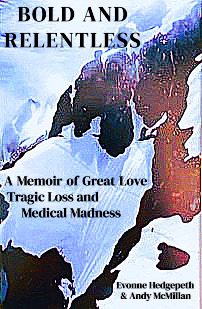
A Memoir of a Great Love, Tragic Loss, and Medical Madness – by Evonne Hedgepeth & Andy McMillan
(in progress)
Photo: Andy McMillan
For anyone who is living with their own illness or disability or caring for a loved one with one, this inspiring combination memoir and advice book by psychologist/educator Evonne Hedgepeth, Ph.D. (with contributions by her environmental scientist husband, Andy McMillan) illustrates a “better way” to obtain and maintain the highest quality of life possible in such circumstances. The story of their near decade long experience with managing multiple myeloma and autoimmune disease, while living with the chronic condition of multiple chemical sensitivities, by using a self-designed integrative treatment approach also provides a clear-eyed, no-holds-barred critique of modern medical systems of all stripes and offers a playbook for how patients and their caregivers can safely navigate such treacherous waters to get their health care needs met without sacrificing their humanity.
The fatal blow for my young, mountaineering husband, Andy McMillan, who with my help had transformed his presumed fatal cancer into a long-term manageable illness using an “integrative”[1] healing program we designed ourselves, came not as a bad fall or other accident but as a result of medical abandonment and staff mistakes, making him yet another casualty of the error-prone modern medical industry.
When Andy was briefly hospitalized with a recurrence of a MRSA infection, the hospitalist on duty refused him adequate pain management and handed him off to Palliative Care, who passed him off to a novice nurse, who administered a triple cocktail of pain and anxiety medications without checking his vitals between doses.
When Andy suddenly stopped breathing, I frantically tried to administer CPR. No hospital staff would respond to our daughter’s urgent pleas for help because someone had placed a “Do Not Resuscitate” order on his chart without our knowledge.
“If you want to make God laugh, just mention your plans.”[2]
As Andy’s life exited his body, and he exhaled his last two breaths into my open mouth, I was beyond shocked and devastated. This was not the outcome we had planned for him or for us.
For nine years, one month and three days after Andy’s shocking diagnosis at age 46 with advanced Bence Jones multiple myeloma, we had approached his illness not as a death sentence with a doctor-projected expiration date, but as a disease that could be managed indefinitely with a high quality of life.
Others had succeeded in becoming long-term survivors of cancer by taking this synergistic approach to healing and wellness (most notably Dr. David Servan-Schreiber, author of Anti-Cancer, who lived 20 years with myeloma.) We had every reason to believe that with the combination of our medical and scientific knowledge, along with faith, hope, discipline, due diligence and competent, compassionate health care, Andy would be among them.
There was almost no written guidance at that time on how to achieve our goal and no meaningful support coming from our providers, a few of whom openly derided Andy’s “Chemo-Lite” approach to treatment and none of whom assisted in coordinating his diverse team of conventional and “alternative” medicine providers. That time-consuming task fell to us.
We designed and implemented individualized integrative treatment protocols for both of us: for Andy to manage his cancer and for me to be as healthy as possible, after I developed stress-related and environmental exposure conditions including an autoimmune disease, lung issues and complex PTSD. We combined and adapted conventional and alternative modalities (CAM) and took lower doses than the doctors and drug companies recommended of their pharmaceuticals.
Andy consulted via phone with several myeloma and cancer experts in the U.S. as needed and stayed on top of the emerging research and new pharmaceuticals that were coming down the “pipeline” by virtually attending the annual conference of the American Society of Hematology (ASH) and doing his own online research in the medical scholarly literature on myeloma-relevant studies.
“You must be a tigress and fight for your mate!”[3]
I served primarily as Andy’s legal advocate and resource coordinator, but occasionally did research projects and consultations with the experts myself, such as talking with the chief scientist at the Baxter Company about the better fit of their dialysate solution for Andy and getting information that our HMO doctors would not or could not tell us (often for cost containment reasons.) When the HMO chief of surgery repeatedly refused to approve a time-sensitive, life-saving surgery for Andy, or any other administrators denied Andy essential care, I went to bat for him and obtained what he needed.
Regarding the use of herbs and supplements, we had regular phone consultations with an internationally recognized herbalist in Oregon, Jonathan Treasure,[4] and consumed numerous targeted and supportive high quality products, to keep us generally healthy, treat our conditions and help us manage side effects of treatments.
Some of the modalities we adopted included consuming an anti-cancer diet, increasing hydration,[5] exercising daily, doing energetic/spiritual practices (e.g., meditation, prayer, Reiki, dance and Qigong), assiduously avoiding toxins, reducing stress, doing anti-neuropathy massages, spending time in nature, traveling, playing, journaling, writing poetry, and many others. We developed a large support system of volunteer helpers, got Andy on several prayer chains, and posted updates to family and friends on our Caring Bridge page.
One of the most helpful treatment modalities we used was acupuncture, which was therapeutic, not just palliative (e.g., pain-relieving and relaxing) as most conventional providers wrongly believe. One acupuncture treatment by our exceptionally qualified provider could literally increase Andy’s blood counts when they were low.
Some modalities that worked well for me, such as Reiki, did not help Andy.
Something that worked for both of us, though, was taking vacations (Andy continued to work as a state agency manager until the last few months of his life.) During Andy’s illness, we took five trips to Maui (snorkeling and swimming nearly every day), many off-the-grid camping trips in our van and, in the last year of Andy’s life, in our Winnebago RV and made frequent visits to the Columbia Gorge, where we hiked, ate meals out at favorite restaurants, chased trains, birded and hung out for hours gazing at snow-covered mountains like Mt. Hood, Mt. Adams, Mt. Rainier and others. Andy took many trips by himself and strongly believed that every day he spent in the mountains lengthened his life. He also encouraged me, his emotionally worn-out caregiver, to take occasional long breaks to spend time alone at a rented cabin on the Pacific Coast.
(See “Treatment and CAM Modalities Used” by Andy and Evonne under Resources/Handouts.)
CAM Approaches Used by Andy PDF / CAM Approaches Used by Evonne PDF
Andy’s second HMO oncologist (we walked away from the first one after only one visit) was emotionally detached and interacted with Andy as if he was a “dead man walking” whom she was simply getting prepped for the standard first line treatment, a bone marrow transplant (BMT) six months after diagnosis. She prescribed him high dose steroids to reduce the cancer burden prior to that presumed procedure.[6]
But Andy’s first follow-up test results at two months showed that his cancer burden had been reduced by far more than she had thought possible: i.e., from his bone marrow being 90% packed with cancer cells at diagnosis to nearly undetectable levels.
When I asked her to characterize Andy’s initial response to treatment in one word, she said simply: “Spectacular.”
Throughout Andy’s illness (and later my own) as well-informed patients and caregivers, we had to “swim upstream” against powerful currents, undertows and riptides of modern medical systems that are designed for, as one clinic manager put it, “pushing as many bodies through here daily as we can.”
Profit-driven attitudes like that call for hypervigilance, self-direction and “pleasant assertiveness” on the part of patients and caregivers in order to obtain appropriate care and avoid medical errors which, at that time (before COVID), were found in an eight-year longitudinal study to be the third leading cause of death in the U.S.[7]
One of the biggest obstacles we faced in obtaining health care without harm was the widespread, unnecessary use of scented products and other sources of toxic chemicals that pervade medical settings, including personal products by medical staff and patients, scented cleaning products and sanitizer, new building materials, recirculated air filtration systems, and many others. Both Andy and I had been overexposed to chemicals at different points in our lives and we both suffered from multiple chemical sensitivities (also known as “environmental illness.”)
As a result, I had to negotiate with each provider to obtain reasonable and effective disability accommodations to at least minimize if not totally prevent further chemical exposures and triggering of physical symptoms. This book shares many of those strategies, which can be helpful to any patient, not just those who are chemically and/or fragrance sensitive.[8] Cancer patients undergoing chemotherapy and kidney patients undergoing dialysis, for example, are already struggling to clear toxins from their bodies. Unnecessary exposures make that task more difficult and patients feel sicker.
Myeloma is also referred to as “cancer of the immune system,” because it affects immune cells and renders them less effective. My background as an infectious disease prevention educator proved useful in helping to protect Andy from opportunistic infections, contaminated food and other such risks to his life. Wearing N95 face masks, which are considered burdensome by many people since COVID, were a routine safety measure for us, along with social isolation, use of unscented hand sanitizer, frequent hand-washing, and sterilization of Andy’s hospital rooms with products (such as hydrogen peroxide and isopropyl alcohol) that made the room safer for Andy without triggering MCS reactions such as migraines and nausea. This was a double-edged sword for me: our indoor environments were safer for us both in some ways. But my serving as the designated sniffer of medical staff before they were allowed to enter our home or Andy’s hospital rooms worsened my MCS condition greatly.
Other less tangible, but realistic, threats to Andy’s survival were the negative attitudes of some medical staff and others. Individuals who were dismissive or inadvertently undermined our efforts to protect Andy from exposures to pathogens, toxins, allergens (like iodine in CT scans), and a host of other errors that happen to patients (unbeknownst to them) were a constant concern for us.
We often experienced resistance to our strategies and unusual health needs by many of the doctors, administrators, staff and bean-counters, in an increasingly litigation risk-averse medical industry, under heavy pressure from their employers, federal and private insurance companies, government oversight committees and Big Pharma, in the larger context of an increasingly litigious culture. Their top priority was (and is) following conventional standards of practice to avoid a lawsuit or a claim against them to federal or state authorities that might result in financial penalties or settlements to patients and their families.
Our top priority in working with our medical providers was avoiding any cause for a claim, especially medical harm. Our need for changes in their regular procedures (i.e., “workarounds,” a concept that is anathema to most medical managers) was at a minimum a source of consternation on the part of staff and, sometimes, outright conflict and occasional denials of care. The stress of having to engage in that delicate dance with so many medical providers and the fear of being turned away from care entirely wore heavily on us both, especially me as the caregiver not the sick patient, who was most often the target of any staff resentment, no matter how pleasant I was in my interactions with them.
In one particularly egregious incident eight months before Andy died I was physically assaulted by an urgent care charge nurse who tried to force me to go into a patient waiting room to register Andy for care, something his doctors had strongly advised me to avoid, due to the risk of my contracting a pathogen that could be passed on to Andy, who was immunocompromised. That tipping point encounter led to a series of negative consequences for us (but none for the offending nurse.) Our health care was withheld indefinitely unless we agreed to sign an illegal, discriminatory contract for care (which we refused to do). I was able to make the legal case to the clinic manager that they were in violation of the ADA and to get our care resumed.
But in the month-long interim, Andy had been denied an oncologist or any contact with staff and his chemotherapy ceased. As a result, we lost control of Andy’s cancer, he lost faith in his providers and, most importantly, he lost hope.
The most impactful decision we had made about Andy’s care, in terms of his longevity, was to avoid a bone marrow transplant, a hard choice that turned out to be the wisest one for him. Three years in a row, we had done our due diligence on the procedure and met with the lead oncologist at the Seattle Cancer Institute, who had co-pioneered the bone marrow transplant. Each time, we decided not to have the transplant for a lot of reasons, the most decisive one based on what one of their own myeloma experts advised us:
“You’re a young man, with an active life. A bone marrow transplant, especially if you need a donor that will cause graft-versus-host disease, will ruin your life.” Another well-known oncologist, in California, advised: “Run like hell the other way. You can manage this disease with drugs.”
Later we learned that many patients who have a BMT survive, on average, about seven years after the procedure and then die of an aggressive leukemia, presumably the result of the heavy doses of chemotherapy administered to them prior to the BMT, in order to kill off all the cancer cells before re-seeding the marrow with healthy cells. However, the genetic makeup of Andy’s cells made him a poor candidate for an “auto” transplant (using his own cells) and a transplant using the cells of a donor often leads to “graft vs. host disease” that would cause the gnarly side effects associated with donor tissue rejection and permanently reduce his quality of life.
“The quality of my life is more important to me than its length.” Andy
Another powerful affirmation of our choice to avoid the BMT was that, not long before his premature death, Andy had a bilateral bone marrow biopsy (one of seven total he had undergone during the nine years.) A genetic study of the findings showed that, unlike in most cancer patients, his cancer had become less, not more aggressive, making his long-term survival more likely.
Thus, our treatment/healing program, we believe, not only helped Andy survive and thrive with an aggressive cancer. Ultimately it had transformed his disease into a less threatening form.
Since Andy’s death in 2014, an increasing number of medical systems and small practices have recognized the value of complementary and integrative approaches to health. Integrative medicine is now considered a “hot topic,” especially in the oncology field.
However, in my observations, their programs more often than not are a marketing add-on that is complementary in character–not a truly “integrative,” coordinated, patient-directed, individualized treatment program.
As just one example I’ve encountered, I called a large medical facility to inquire about the exact nature of their “integrative” oncology program. I asked if it included acupuncture. Their answer: “Only if the doctor approves it.”
Thus, traditionally conventional medical facilities have a long way to go before they can get past the institutional, fiscal and bureaucratic barriers to providing truly integrative, coordinated and more effective health care to patients.[9]
In sum, this book describes a pioneering example of medical successes that can be achieved if patients and their caregivers choose to draw upon our experience, while charting their own course in collaboration with informed, open-minded, supportive providers. Every patient, caregiver, parent of an affected child, concerned loved one, medical manager, provider and health care decision-maker can find something in this book that could contribute to better health care services and wellness for all of us.
[1] See Resources/Handouts for “Generations of Oncology Attitudes about Approaches to Cancer Treatment” by Evonne Hedgepeth
[2] Paraphrased quote by Anne Lamott, author of Bird by Bird, Traveling Mercies and other books
[3] Dr. Vo Nguyen, chief nephrologist
[4] https://www.botanical-medicine.org/Botanical-Medicine-Speakers/Treasure-Jonathan, author of The Thinking Patient’s Guide to Cannabis and Cancer and Herb, Nutrient, and Drug Interactions: Clinical Implications and Therapeutic Strategies, https://www.amazon.com/Herb-Nutrient-Drug-Interactions-Implications/dp/0323029647?ref_=ast_author_dp
[5] Hydration was especially important for Andy because his form of myeloma, Bence Jones version, targets the kidneys. He consumed at least a gallon of water per day, to flush myeloma proteins out of his kidneys.
[6] What she didn’t tell us was that taking high doses of Dexamethasone can cause what the drug company literature euphemistically refers to as “disturbing dreams.” We later learned the truth: that they can cause what Andy characterized as “nightmares too horrifying to ever forget or to speak of” and, according to the medical literature, can cause permanent psychosis.
[7] Makary, M.A. & Daniels, M. (2016) “Medical error–the third leading cause of death in the U.S.,” British Medical Journal, BMJ, 353.
[8] Studies on prevalence of these conditions by Dr. Anne Steinmann and others have found that 1 in 4 Americans are chemically sensitive and 1 in 3 are fragrance sensitive. Many patients, like Andy and Evonne, were both.